Bite alarm guides
Bite Alarm Receivers: Range, Pairing and Features
A receiver lets you hear a take from your bivvy. Here is how they work, why quoted range is rarely what you get, and which features matter.

In short
- A receiver copies your alarms' bleeps and LED colours by radio, so you can turn the heads down and still hear every take.
- Quoted ranges, from 100 m to over 750 m, are measured in open ground; trees, banks and bivvy walls reduce them.
- Receivers are almost always brand-specific: check compatibility before mixing alarms.
- Useful extras include vibration, last-event recall, anti-theft alerts and rechargeable power.
What a receiver does
A transmitting alarm sends a short radio message every time it registers line movement. The receiver, a handset you keep in your bivvy or pocket, plays the matching tone and lights the matching LED. On most modern systems it copies each alarm's colour automatically: the Delkim Rx-D v2, Fox Mini Micron X receiver and Trakker DB7-R receiver all sync to the colour you set on the head.
With a receiver you can turn the alarm heads right down, or off completely, and keep the bank quiet. That matters on busy day-ticket waters, at night, and when you're a few swims away making a brew.
How far will a receiver reach?
Makers quote range as a single figure measured in ideal conditions. Here is what they claim for the systems we cover:
| System | Quoted range |
|---|---|
| Nash R4 receiver | Over 750 m, subject to conditions |
| Steve Neville Remote | Up to 500 m |
| Sonik Herox | Up to 150 m |
| JRC Radar CR | 120 m in an undisturbed area |
| Prologic BAT+ | 100 m |
| Korum KRI | Up to 100 m |
| Delkim, Wolf, Trakker, Fox | No single figure published by the stockists we checked |
What cuts range
- Obstacles: trees, high banks, vehicles and the bivvy itself all absorb or block the signal.
- Height: a receiver on the ground performs worse than one hung up in the bivvy.
- Weak batteries: range often falls as the alarm or receiver battery runs down.
- Interference: other electronics and radio users nearby can reduce reliability.
Several systems include a range test (Wolf's Icon X1 has one) so you can check the link before you settle in. Do it every time you fish a new swim.
Pairing and channels
Each alarm has to be "paired" or "programmed" to the receiver once, after which it is remembered. Receivers differ in how many alarms they accept:
- Delkim Rx-D v2: up to 12 Txi-D v2 heads.
- Trakker DB7-R receiver: up to four alarms per channel, 16 in total.
- Nash R4 receiver: four channels for single alarms, plus a buddy channel for up to 32 more, useful when fishing with friends.
- Gardner ATTx V2: five channels; the ATTx Deluxe extends this further.
- Steve Neville receiver box: four channels.
Modern systems use coded signals so your receiver ignores the angler in the next swim. Korum calls this a rolling code system on its KBI Compact set; JRC says its CX receiver prevents interference with other alarms on the same lake.
Compatibility: can you mix brands?
Generally, no. Receivers are designed for their own alarms, and sometimes only for one model: the Nash S5R receiver doesn't work with the non-radio Siren S5, and the Fox MX receiver only works with MX-series heads. The notable exception is Gardner's ATTx V2 system, which can take a signal from almost any alarm with a jack-plug output (such as older Delkims, Nevilles and Fox alarms) via an ATTx transmitter plugged into the alarm.
Receiver features worth having
- Vibration
- Lets you run everything silent. Most receivers here have it.
- Volume control
- Including a silent setting, independently of the heads.
- Last event recall
- Shows which alarm sounded last (Delkim's recall, Trakker's LER).
- Anti-theft alerts
- Delkim, Wolf and Nash systems warn you if an alarm is switched off or moved.
- Torch
- A built-in light on the Delkim Rx-D v2, Wolf HUBB and Sonik Herox receiver.
- Rechargeable battery
- The Nash R4 receiver charges by USB-C, with a guide run time of around 20 weeks.
- Weather protection
- A receiver often lives on a bivvy table: splashproof is the minimum.
Setting up a receiver in the bivvy
- Fit fresh batteries, or charge it fully if it's rechargeable, before you leave home.
- Pair any new alarms at home, following the manual, so you're not fiddling in the dark.
- Once the rods are out, hang the receiver at head height inside the bivvy rather than leaving it on the groundsheet.
- Ask a friend to lift each indicator, or do it yourself and walk back, to check every alarm comes through.
- Set vibration on, and set the volume loud enough to wake you but not your neighbours.
- Check the low battery warning before bed: a warning at midnight means a flat receiver by dawn.
Do you need a receiver at all?
If you fish day sessions sitting next to your rods, probably not: the alarm head is enough, and a non-radio alarm such as the Delkim Ev-D saves money. If you fish overnight, use a bivvy, or ever step away from the rods, a receiver is one of the most useful things you can buy. Systems like the silent ATTs rely on one entirely.
Ready to compare? See every system's receiver in our comparison table, or learn the other terms in the glossary.
Questions and answers
Do I need a receiver for my bite alarms?
Only if you fish away from your rods or overnight. A receiver plays your alarms' bleeps in the bivvy so you can turn the heads down. For day sessions beside the rods, standalone alarms are enough. Receivers explained.
How far do bite alarm receivers work?
Makers quote from about 100 m (Prologic BAT+, Korum KRI) to over 750 m (Nash R4), but these are open-ground figures. Trees, banks and your bivvy reduce real range, so test the receiver from where you'll sit. What affects range.
Can I use a different brand of receiver with my alarms?
Usually not: receivers are designed for their own alarms. The main exception is Gardner's ATTx V2 system, which can take a signal from most alarms with a jack-plug output via a plug-in transmitter.
Alarms covered in this guide
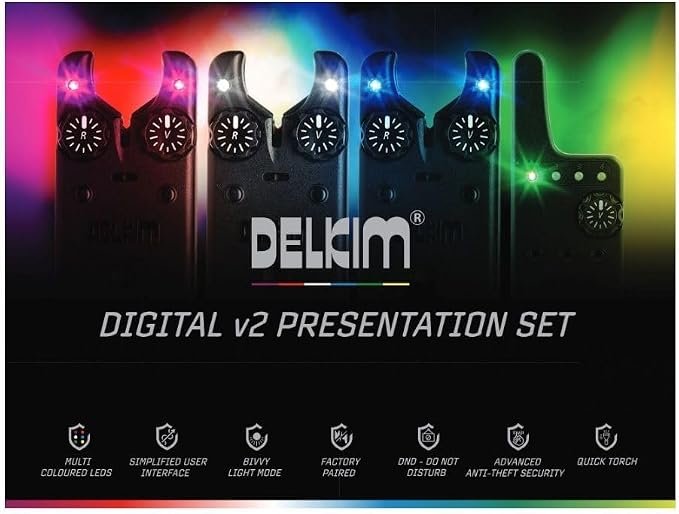
Delkim Txi-D v2 Presentation Set
Delkim's flagship piezo vibration alarm with 32 tones, six LED colours and the Rx-D v2 receiver.
View full specs (Delkim Txi-D v2 Presentation Set)
Nash Siren R4 Bite Alarm
Nash's flagship alarm, built around speed-responsive sensing, with a USB-C rechargeable receiver rated beyond…
View full specs (Nash Siren R4 Bite Alarm)
Wolf Icon X1 Bite Alarm
A compact UK-made alarm with a 1000 mAh rechargeable battery, USB-C charging and HUBB receiver link.
View full specs (Wolf Icon X1 Bite Alarm)As an Amazon Associate we earn from qualifying purchases. Some other links on this site are affiliate links too; it never changes the price you pay.