Bite alarm guides
How to Choose a Bite Alarm
Five questions narrow the choice fast. Then we suggest alarms at four budgets, from complete starter sets to flagship systems.

In short
- Decide first whether you need a receiver: it changes which alarms you can consider.
- Pick a sensing type for your venues: roller wheel suits most anglers; vibration, dual or wave sensing suit specific conditions.
- Check the battery type, build and warranty, not just the feature list.
- Good complete sets start at budget prices; flagships add sensing technology, range and security.
Five questions to ask first
1. Will you fish overnight or away from the rods?
If yes, you need transmitting alarms and a receiver. If you only fish day sessions beside your rods, standalone alarms are fine and cheaper. Our receivers guide explains range and pairing.
2. What are your waters like?
Small, sheltered lakes and rivers suit almost any good roller wheel alarm. Big, exposed waters, boats and swell favour alarms designed to ignore wave action, such as the Nash Siren R4 or Trakker DB7-R. Pressured venues with tiny indications are where vibration and dual sensing earn their keep. See roller wheel vs vibration.
3. How many rods?
Most sets come as 2+1, 3+1 or 4+1 (alarms plus receiver). Buying a set is nearly always cheaper than heads and receiver separately. Check the rod limits on your licence and venue rules.
4. How do you like to control things?
Some anglers love menus and dozens of settings; others want a dial they can turn by feel in the dark. Trakker's DB7-R uses indexed wheels for every setting; Steve Neville keeps volume to three positions; Nash's R4 uses a button menu.
5. What batteries do you already carry?
If all your kit runs on AAA, an alarm that does too saves hassle. If you hate disposable batteries, a USB-C rechargeable alarm like the Wolf Icon X1 may suit. See the batteries guide.
Our suggestions by budget
Budget bands are approximate and based on typical UK set prices at the time of writing; prices change, so check current offers on each alarm's page.
Entry level: complete sets for beginners
- Korum KRI remote set: compact, rugged, adjustable snag ears and a 100 m receiver.
- Sonik Herox: eight sensitivity levels, a four-channel receiver and a bivvy lamp that lights on a take.
- Prologic BAT+: waterproof, deep rod recess, 100 m receiver.
- JRC Radar CR: simple controls and a vibrating receiver.
Mid-range: better build or a specialist design
- Fox Mini Micron X and Micron MX: Fox's D-Tec roller sensing with receivers.
- Nash Siren S5R: very compact with a Nash receiver.
- Gardner ATTs: silent heads for stealthy fishing.
- Delkim Ev-D: Delkim vibration sensing without a receiver.
Upper mid-range: flagship features for less
- Trakker DB7-R: eight-magnet roller, Intelli-Sense Mode, 16-alarm receiver.
- Steve Neville Remote: a proven classic, UK-made, up to 500 m.
- Wolf Icon X1: UK-made and rechargeable.
Flagship: the most advanced systems
- Delkim Txi-D v2: vibration sensing, 32 tones, anti-theft and a 12-head receiver.
- Nash Siren R4: speed and wave sensing, USB-C receiver rated over 750 m.
- Wolf Icon Qi: dual vibration and roller sensing with the HUBB receiver.
Buying for specific situations
- River fishing for barbel or chub
- A compact, rugged alarm with good sensitivity control, such as the Korum KRI or Nash S5R; flow causes constant line movement, so a controllable sensitivity matters more than range.
- Big, windswept waters and boat fishing
- Alarms built to ignore wave action, such as the Nash Siren R4 or Trakker DB7-R, plus a receiver with plenty of range.
- Stalking and short sessions
- Small, light heads such as the Gardner ATTs or Fox Mini Micron X, which pack away easily.
- Winter fishing
- Vibration sensing avoids frozen wheels; otherwise use covers. Pick an alarm whose batteries you can keep warm and replace easily.
- Long sessions abroad
- A long-range receiver, anti-theft alerts and batteries you can buy anywhere, or a rechargeable system and a big power bank.
What to check before you buy
- Exact model name. Mini Micron vs Mini Micron X, S5 vs S5R, BAT vs BAT+: one letter decides whether there's a transmitter.
- Set contents. Does "3+1" include cases, snag bars or indicators?
- Indicator socket. Will your illuminated hangers fit (2.5 mm jack, or Nash's MMCX)?
- Warranty and registration. Nash and Wolf extend warranties when you register.
- Second-hand alarms. Check the battery compartment for corrosion and test every function, including the receiver link.
Five common buying mistakes
- Buying alarms first and a receiver later. Many alarms only work with one receiver model; buy a matching set if you think you'll want one.
- Paying for features you won't use. Thirty-two tones and app-style menus are wasted on a day-session angler.
- Ignoring the indicator socket. Your existing illuminated hangers may not fit a new alarm.
- Judging range by the number on the box. Open-ground claims rarely match a tree-lined swim.
- Forgetting the warranty. Register alarms that offer an extended warranty on registration.
Where to buy
Buy from established UK tackle retailers or Amazon sellers you trust, so you get UK warranty support. Each alarm's page links to current prices. If you'd like to compare everything side by side first, use our comparison table or browse by brand.
Questions and answers
What is the best bite alarm for a beginner?
A complete budget set with a receiver, such as the Korum KRI, Sonik Herox or Prologic BAT+, gives you everything you need to start. See our buying guide.
What does 3+1 mean on a bite alarm set?
It means three alarms plus one receiver. Sets are usually sold as 2+1, 3+1 or 4+1 and cost less than buying the parts separately.
Alarms covered in this guide
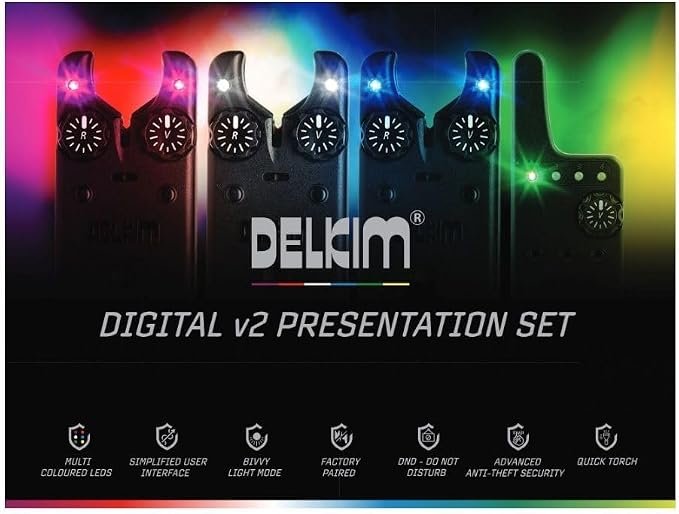
Delkim Txi-D v2 Presentation Set
Delkim's flagship piezo vibration alarm with 32 tones, six LED colours and the Rx-D v2 receiver.
View full specs (Delkim Txi-D v2 Presentation Set)
Nash Siren R4 Bite Alarm
Nash's flagship alarm, built around speed-responsive sensing, with a USB-C rechargeable receiver rated beyond…
View full specs (Nash Siren R4 Bite Alarm)
Wolf Icon X1 Bite Alarm
A compact UK-made alarm with a 1000 mAh rechargeable battery, USB-C charging and HUBB receiver link.
View full specs (Wolf Icon X1 Bite Alarm)As an Amazon Associate we earn from qualifying purchases. Some other links on this site are affiliate links too; it never changes the price you pay.