Bite alarm guides
Bite Alarm Specifications Explained
Sensitivity settings, magnets, latching times, range claims and battery types: a plain-English guide to every line on a bite alarm spec sheet.
In short
- Sensing method and sensitivity decide what the alarm notices; everything else decides how it tells you.
- More sensitivity steps or tones is not automatically better: clear, easy controls matter more on a dark bank.
- Range figures are maker claims in open ground; real-world range is usually shorter.
- Check the battery type, the receiver compatibility and whether the indicator socket suits your hangers.
Sensing specifications
- Sensing method
- Roller wheel, vibration (piezo), dual or speed-responsive. This is the single most important spec; see roller wheel vs vibration.
- Magnets
- On roller alarms, more magnets in the wheel mean more bleeps per centimetre of line. Steve Neville uses four, Trakker's DB7-R eight. Gardner's ATTs lets you change wheels.
- Sensitivity settings
- How much movement the alarm needs before it sounds. Ranges run from two settings (Fox Micron MX+) to eight (Sonik Herox, Trakker DB7-R, Wolf Icon Qi).
- Drop-back indication
- A separate tone or LED pattern when the line goes slack. Almost every modern alarm has it; check that the tone is clearly different.
- Recoil elimination
- Wolf's term for ignoring the small backwards movement of line after a forward pull, so you don't get a false drop-back signal.
Sound specifications
- Tones
- How many pitches you can choose. Delkim's Txi-D v2 offers 32, the Ev-D 16, the Mini Micron X four. You only need enough to tell your rods apart.
- Volume
- Usually stepped, often including silent for use with a receiver. Steve Neville keeps it to three: high, low and silent.
- Speaker type
- Cone speakers (Fox, Trakker) tend to sound fuller than small piezo buzzers. Some alarms, such as the ATTs, have no speaker at all.
- Mute and stealth modes
- Mute silences the head; stealth modes may also switch off LEDs so you don't light up the bank.
Light specifications
- LED colours
- Fixed (one colour per alarm) or changeable on the head. Six is common (Delkim, Fox MX, Trakker, Wychwood Solace); Wolf's Qi offers seven.
- Latching LED
- Stays lit after an indication. Look at the latching time: 10 seconds on the Korum KRI, 15 on the JRC Radar CR, 10 to 40 on the Wychwood AVX.
- Night light
- A low glow so you can find the alarm in the dark.
- Brightness levels
- Delkim's Txi-D v2 has eight; dimmer settings are kinder on pressured waters.
Receiver and range specifications
- Range
- The maker's claim for how far the receiver can be from the alarm, normally measured in open ground. Claims run from 100 m (Prologic BAT+, Korum KRI) to over 750 m (Nash R4 receiver). Trees, banks and bivvies all reduce it.
- Channels and pairing
- How many alarms the receiver can show. The Delkim Rx-D v2 pairs up to 12 heads; the Trakker DB7-R receiver 16; the Nash R4 receiver four channels plus a buddy channel for 32 more.
- Vibration
- A receiver that vibrates lets you keep everything silent.
- Anti-theft
- Alarms that warn the receiver if they are switched off or moved, a feature on Delkim, Wolf and Nash systems.
Our receivers guide covers all of this in more depth.
Power specifications
- Battery type
- PP3 9V, AAA, CR2, 23A-type 12V or built-in lithium-ion. It affects running costs and how easy spares are to find. See the batteries guide.
- Battery life
- Usually quoted loosely ("a season", "up to six months"). Wolf is unusually specific: 375 to 500 hours paired for the X1.
- Low battery warning
- Essential. Nearly every alarm here has one.
- Power-on protection
- Stops the alarm switching on in your bag and draining the battery (Trakker's PS system; Wolf and Gardner use the hard case as a switch).
Build specifications
- Weatherproofing
- Makers use terms such as "weatherproof", "waterproof" and "splash-proof" loosely, and few quote an IP rating. Sealed electronics and few openings are good signs.
- Snag ears
- Raised sides that stop the rod being pulled off the alarm. Fixed, removable (Nash R4) or adjustable (Korum KRI).
- Thread
- The stud that screws into a bankstick or buzz bar. UK carp tackle uses a 3/8 inch thread; the DB7-R's is stainless steel.
- Indicator socket
- Usually a 2.5 mm jack that powers an illuminated hanger. Nash's R4 uses an MMCX bayonet instead, with an adapter supplied.
- Size and weight
- Rarely published, but useful for travel. The DB7-R is 98 g; the Nash S5R measures 80 x 38 x 37 mm.
A spec sheet checklist
Use this when comparing two alarms. If an answer isn't on the listing, ask the retailer or check the maker's manual.
| Question | Why it matters |
|---|---|
| What sensing method does it use? | Decides how it behaves in wind, rain and frost |
| How many sensitivity steps, and how are they set? | Fine control helps; dials are easier in the dark than menus |
| Is the drop-back tone clearly different? | You need to know instantly when a fish swims towards you |
| Does it transmit, and to which receiver? | Receivers rarely work across brands or models |
| What battery, and how is it switched off? | Running cost, spares and avoiding a flat alarm |
| What socket does it have for indicators? | Your illuminated hangers must fit |
| What warranty, and do you need to register? | Some makers extend warranties on registration |
What really matters
For most anglers the order of importance is: sensing method, ease of setting sensitivity, a clear drop-back signal, a receiver you trust, and batteries you can find. Everything else is preference. When you're ready, filter every alarm by sensing type in our alarm listings or see them all in one comparison table. Unsure of a term? Try the glossary.
Questions and answers
What is a latching LED?
An LED that stays lit for a set time after an indication, so you can see which rod moved by the time you reach the rods. Times vary, for example 10 seconds on the Korum KRI and 15 seconds on the JRC Radar CR.
Alarms covered in this guide
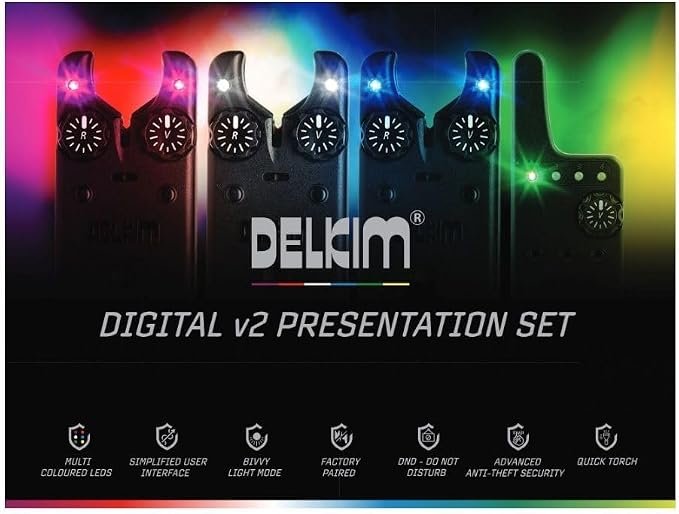
Delkim Txi-D v2 Presentation Set
Delkim's flagship piezo vibration alarm with 32 tones, six LED colours and the Rx-D v2 receiver.
View full specs (Delkim Txi-D v2 Presentation Set)
Nash Siren R4 Bite Alarm
Nash's flagship alarm, built around speed-responsive sensing, with a USB-C rechargeable receiver rated beyond…
View full specs (Nash Siren R4 Bite Alarm)
Wolf Icon X1 Bite Alarm
A compact UK-made alarm with a 1000 mAh rechargeable battery, USB-C charging and HUBB receiver link.
View full specs (Wolf Icon X1 Bite Alarm)As an Amazon Associate we earn from qualifying purchases. Some other links on this site are affiliate links too; it never changes the price you pay.